NCCD360 Just Got Better: Explore the Latest Enhancements

Discover the latest NCCD360 enhancements designed to streamline everyday tasks, improve visibility across records and create a more seamless and collaborative experience for school staff in this post.

1. New Guidance Feature

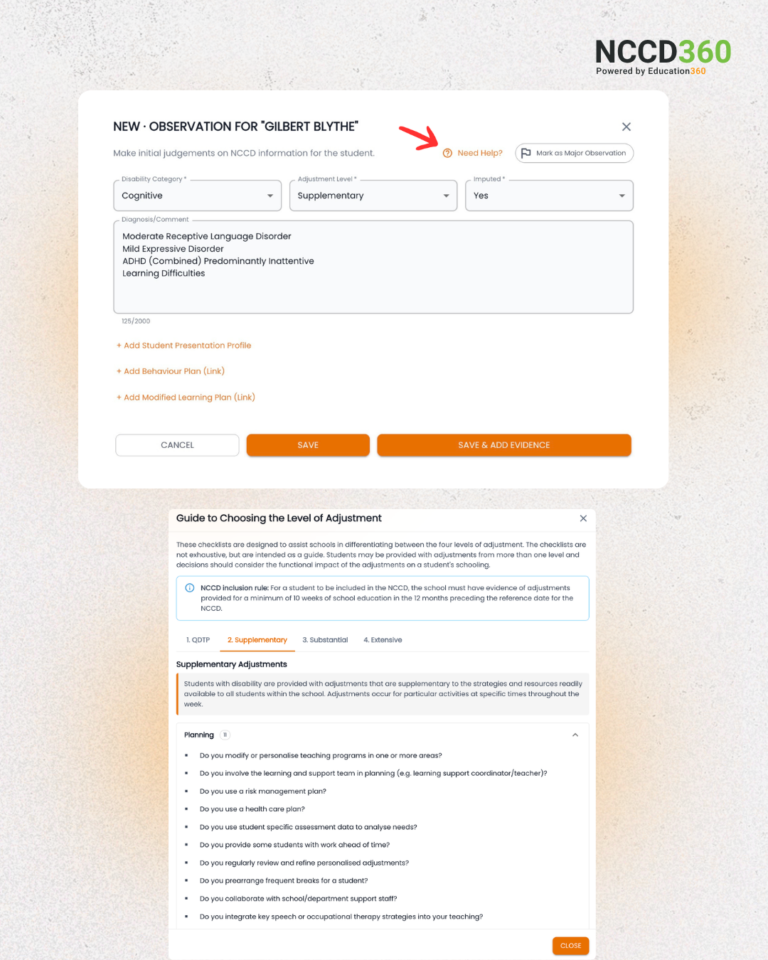
Determining the right Level of Adjustment for students is now easier with our new Need Help feature. Accessible from the Observation screen, staff can instantly access a guided checklist outlining the differentiation and support requirements across all four Levels of Adjustment.  

The feature is designed to improve consistency, clarity and confidence when making NCCD adjustments.
2. Student Presentation Profile

We’ve introduced Student Presentation Profile within Observation, now automatically included in the IEP (Individual Education Plan) Template.  

This feature provides a holistic and up-to-date view of each student, including strengths, challenges, academic progress and their social, emotional and functional capabilities.

By bringing all key information together in one place, schools can more easily link student needs to functional impacts, supporting informed decisions-making, targeted planning and evidence-based adjustments.

3. Functional Impact Categories

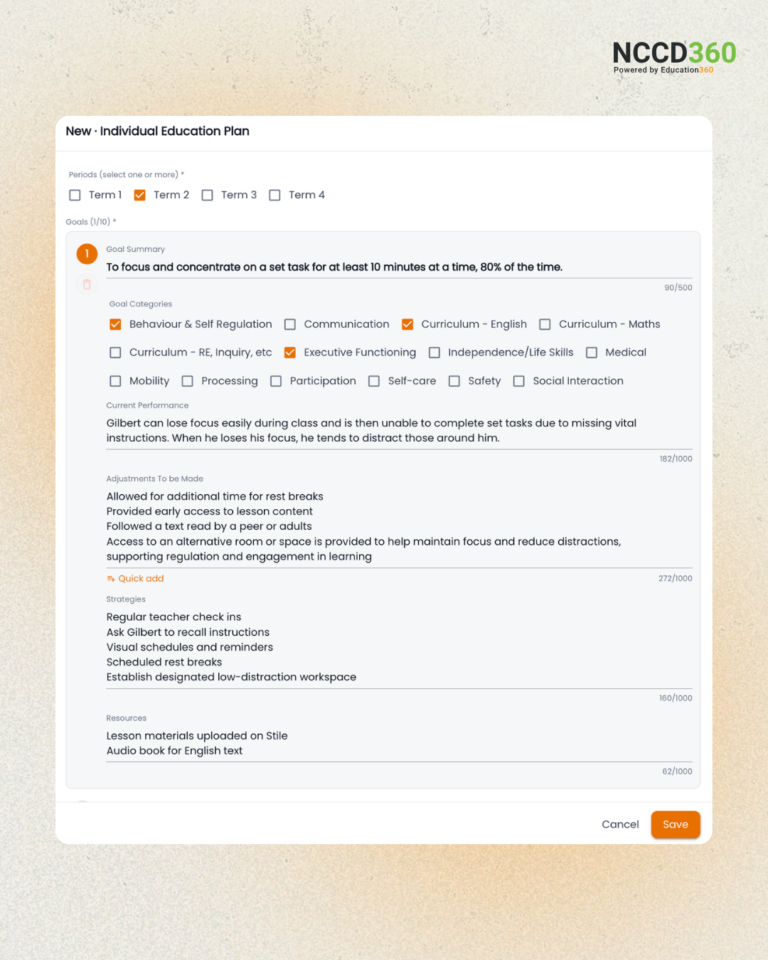
To further improve workflow and visibility, we’ve introduced Functional Impact Categories within the IEP.

This enhancement allows staff to directly link Functional Impact areas to IEP goals and adjustments within a single structured template, reducing the need to switch between multiple systems.

The IEP now centralises student goals, current academic performance and targeted adjustments into one connected view, making documentation more consistent and collaboration across teams more efficient.

By aligning learning goals and strategies with key functional areas such as communication, participation, behaviour and curriculum access, staff can plan, monitor and review student progress with greater clarity and confidence.
4. Capturing Student Voice in Consultation and Collaboration

NCCD360 now enables staff to capture meaningful consultation conversations between teachers and students directly within the IEP process.

This feature allows student perspectives, reflections, and experiences to be accurately documented and linked to specific IEP goals and adjustments, strengthening the connection between planning, support strategies, and functional skills development.

By incorporating student voice more seamlessly into documentation workflows, schools can support a more collaborative and student-centred planning approach.

Empowering schools with smarter documentation, clearer visibility, and more connected student support.

With these latest enhancements in NCCD360, schools can now benefit from a more unified and connected documentation process. Together, they are intentionally introduced to enhance visibility and support more efficient collaboration across teams.


Student Transfer Is Here: Making NCCD Evidence Sharing Seamless

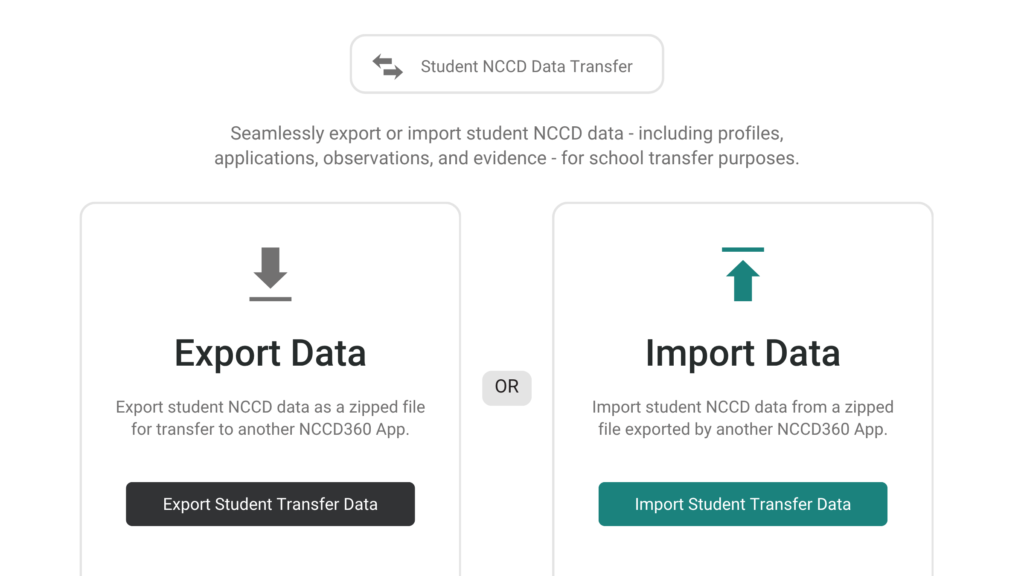
With the introduction of NCCD360 new Student Transfer feature, teachers and school leaders no longer need to navigate the challenges of unsynchronised NCCD evidence when students move between schools. Designed to support smoother, more consistent transitions, Student Transfer ensures critical student information travels with them, accurately, efficiently, and in step with frequent student movement.

So, what does this mean in practice?

Inside NCCD360, schools can now upload complete student records in a single click, seamlessly transferring existing NCCD evidence without manual searching, re-entry, or duplication. This simplifies the evidence management process, reduces administrative workload, and minimises the risk of fragmented or missing data.

The result? A more streamlined and reliable approach to NCCD record-keeping, saving time for educators while enabling greater accuracy and stronger, more consistent applications across schools.

One click. Total control. Seamless transitions.
With the new Export Data feature, teachers and school leaders can export student records instantly, staying in full control of exactly how many students to upload.

Built to address inconsistencies in data transfer, Export with Files feature consolidates all key student information, including attachments and supporting evidence, into a single ZIP file. This creates a complete, connected view of NCCD records as students move between schools.

For destination schools, student profiles are presented as cards, with data integrity verified at a prior checkpoint before transfer. Student Transfer not only simplifies the movement of records but also ensures consistency and accuracy by identifying and reducing duplication across systems. The result is trusted, ready-to-use data from the moment it arrives.

There's even more to like

  • Every export includes a checksum, NCCD360 automatically verify data before import, with warnings for any records that fail validation.
  • Decisions made at Match & Confirm stage can be reviewed and undo before importing.
  • Only approved applications are included in exports.
  • Duplicate Student IDs are detected and automatically merged into a single card.

Student Transfer doesn’t just simplify information movement, it keeps NCCD evidence continuously synchronised, accurate, and high-quality through built-in verification.

Where data moves effortlessly, Education360 simplifies student transitions, saving time, reducing admin, and keeping organisations stay connected.

Building a Defensible NCCD Approach: Insights from the April Symposium

NCCD Symposium April 2026 by Education360

Is your NCCD Evidence Strong Enough for Review

Our second Online NCCD Symposium of the year brought together critical insights into effective evidence gathering as schools prepare for submissions this August. Here are the key takeaways.

Triage: Where Are You Now?

For many schools, NCCD evidence is spread across multiple systems, making it difficult to form a clear, consistent picture. The first step is a rapid, honest assessment of your current position. By reviewing evidence across key categories, schools can identify gaps, inconsistencies between staff or faculties and areas where documentation is difficult to access or verify.

This stage isn’t about fixing everything; it’s about gaining clarity on what matters most.

A useful question at this stage is: “Would someone outside our school understand this?”  

When You're Not Evidence Ready

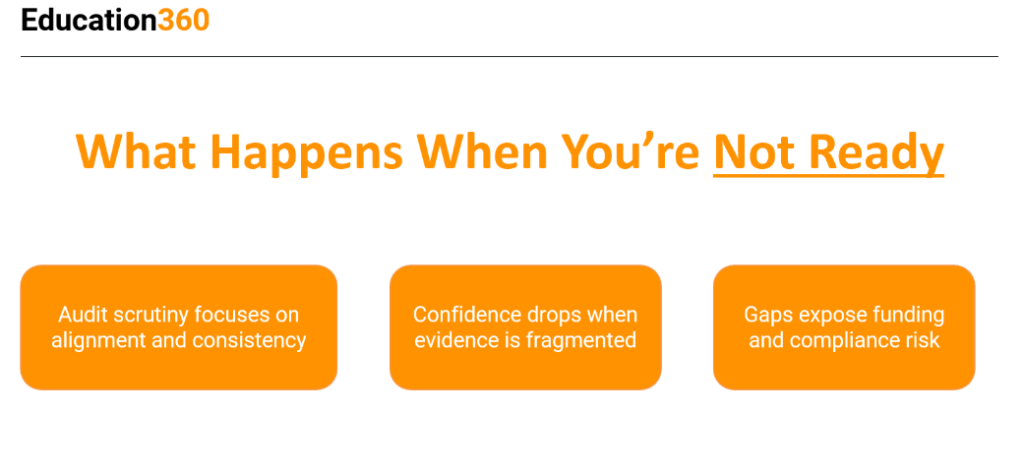
Auditors are not looking for perfection, they are looking for consistency and alignment. When documentation is fragmented or varies across teachers or faculties, it becomes difficult to present a clear, defensible picture of student support.

This challenge is often compounded by regular movement of students throughout the year, which can quickly make records outdated, repeated or inconsistent. Without a coordinated approach, schools may find themselves under pressure during submission periods, spending valuable time reconciling information instead of confidently validating it.

When data are fragmented, teachers must rely on individual knowledge, increasing the risk of gaps and weakening the link between adjustments and evidence. Strong practice, by contrast, is built on consistently maintained documentation and regular review of adjustments. Effective documentation should present a clear, traceable narrative that aligns student needs, consultation and classroom practice.     

From Disarray to Defensible

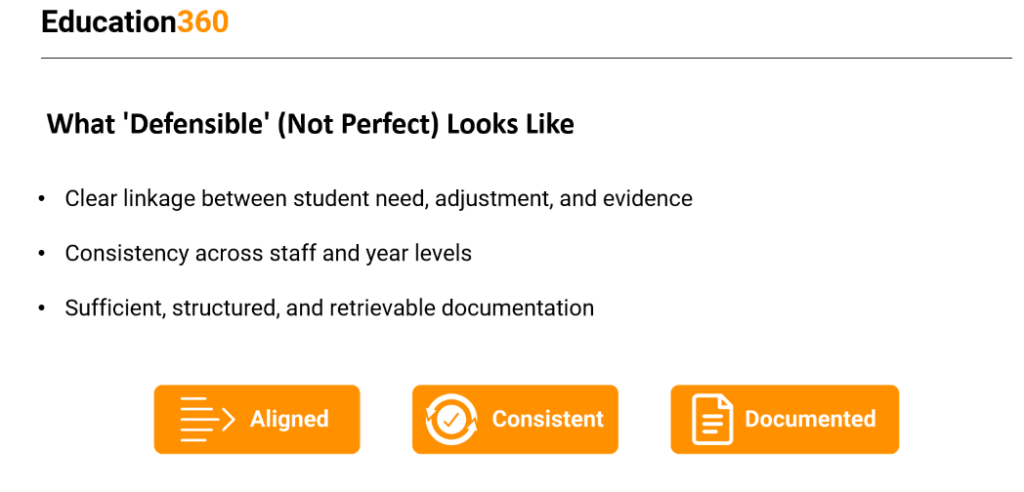
Defensibility is not about perfection or completeness. It is about how you can clearly and confidently explain the decisions made and the evidence supporting them. When this defensible position is achieved, auditors and external organisations can readily see the connection between identified student needs, adjustments and the rationale behind the evidence.

The goal is confidence at any stage of the NCCD timeline.

Why Schools Choose NCCD360

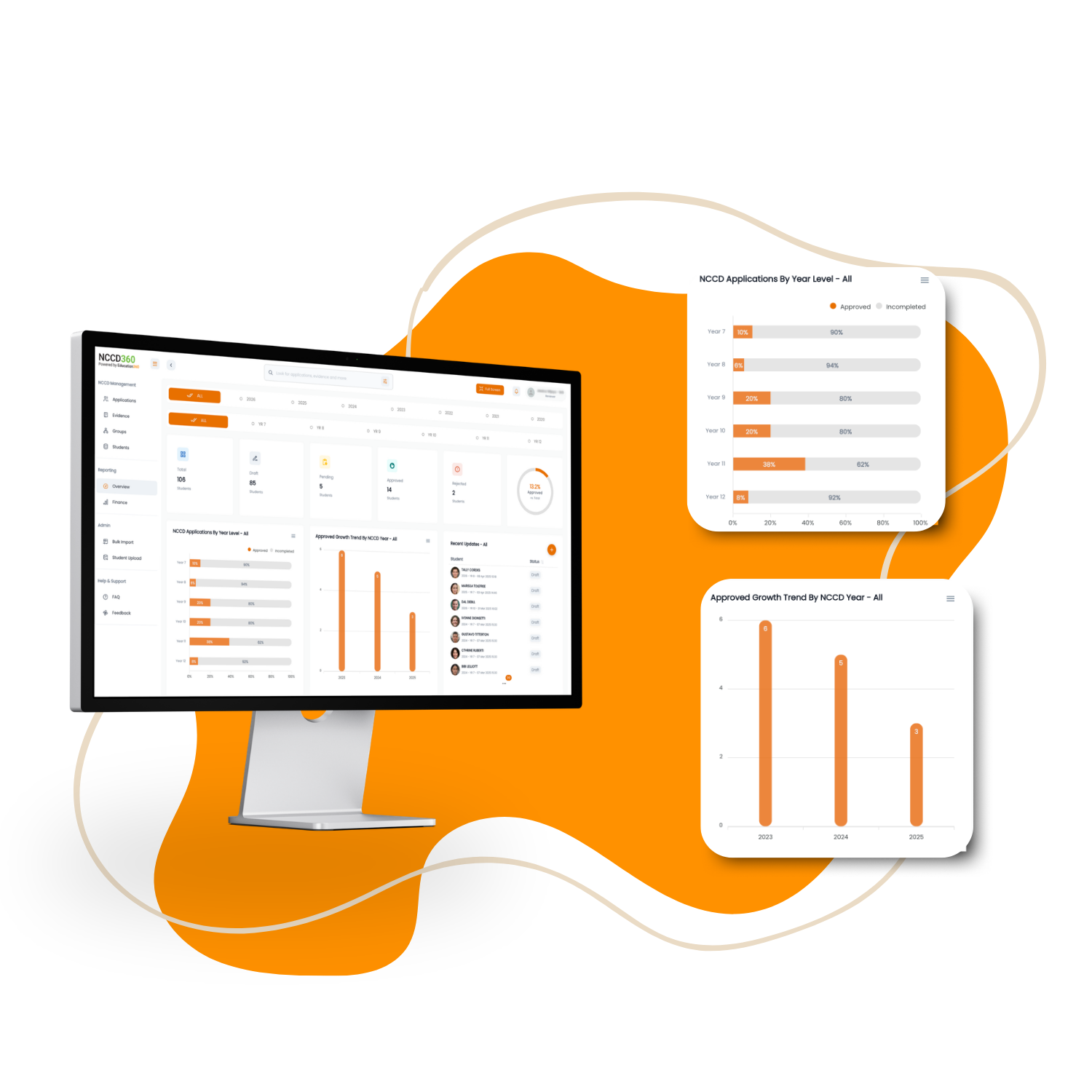
NCCD360 brings clarity and confidence to NCCD processes by providing a single source of truth and a coherent, system-wide view of student documentation. With the Student Transfer feature, schools can export comprehensive records backed by checksum verification, ensuring data integrity and flagging inconsistencies before import. Safeguards, including reversible Match & Confirm decisions, inclusion of only approved applications, and automatic merging of duplicate student IDs, ensure accuracy, transparency and control.

More than a compliance tool, NCCD360 enables schools to move from reactive practices to repeatable, sustainable processes. It reduces reliance on individual staff knowledge while supporting consistent workflows and alignment across organisations. As part of the Education360 ecosystem, it demonstrates why Education360 remains the Top 1 data platform for schools, saving time, reducing administrative burden and turning data into successful NCCD applications.


Rethinking the future: 3 AI-driven trends reshaping education in 2025

Teacher using AI-powered dashboard to personalise student learning in a modern classroom, representing the future of education in 2025.


As classrooms continue to evolve into dynamic hubs of data, design, and digital collaboration, education in 2025 is no longer defined by devices, but by the intelligence behind them. Artificial Intelligence (AI) is not just a tool; it’s a catalyst for a seismic shift in how we learn, teach, and design educational systems. Below, we explore three major AI-powered trends transforming the global education landscape, backed by current data and global insight.

1. Adaptive Learning: From One-Size-Fits-All to Precision Pedagogy 

The days of standardized instruction are fading. In their place, adaptive learning systems, powered by AI, are creating hyper-personalized learning journeys that evolve in real time. Platforms like Century Tech and Squirrel AI already use machine learning algorithms to assess a student’s performance and emotional engagement, adjusting content accordingly.

According to HolonIQ’s 2024 Global Education Outlook, adaptive learning solutions are projected to surpass $8 billion in market value by 2027. These platforms not only increase student retention by up to 20% but also reduce teacher burnout by automating repetitive tasks like assessments and learning path adjustments.

In Australia, government-funded pilot programs in Victoria and New South Wales have shown a 12% improvement in literacy outcomes among Year 5 students using AI-powered reading platforms. This shift signals a move from curriculum delivery to learner design, where data, not tradition, drives the educational journey.

2. Teacher-AI Collaboration: The Rise of Augmented Educators


Rather than replacing educators, AI is equipping them with new capabilities. Tools like TeachFX and Curipod are giving teachers real-time feedback on student engagement and helping them craft inclusive, differentiated lesson plans at speed.

McKinsey’s 2023 report on “The Future of Work in Education” revealed that over 40% of a teacher’s administrative workload could be automated without compromising learning quality. That means more time for teachers to focus on emotional intelligence, mentorship, and creativity, qualities that no machine can replicate.

In Finland, where AI integration in schools is state-backed, 67% of educators reported feeling more empowered, not less, after using generative AI tools to co-design student materials. The shift isn’t from teacher to AI, but from solo instructor to empowered collaborator.

3. Ethics, Equity, and the Algorithm: The New Digital Literacy


With great power comes the need for thoughtful design. As AI becomes embedded in classrooms, questions about bias, transparency, and data governance are becoming central to digital literacy programs. UNESCO’s 2024 Global Report on AI in Education urges institutions to go beyond technical skills and cultivate what they call “algorithmic conscience” among students.

In the U.S., over 60% of K–12 districts using AI tools failed to disclose how student data was collected and used (Center for Democracy & Technology, 2023). In response, countries like Australia are integrating AI ethics into the general curriculum. The eSafety Commissioner’s 2025 framework now mandates that schools teach students how to critically question AI outputs, not just use them.

The next generation must not only be users of AI, but conscious stewards of it. Equity in AI access, understanding how algorithms are built, and calling out digital redlining are as essential as knowing how to prompt ChatGPT.

Schools that embrace AI not as a quick fix, but as a co-author in the learning process, will be the ones that truly prepare students for the complexity of tomorrow.


AI isn’t replacing education. It’s rewriting its script. As we move through 2025, the conversation must shift from whether to use AI to how we use it, ethically, equitably, and creatively. Schools that embrace AI not as a quick fix, but as a co-author in the learning process, will be the ones that truly prepare students for the complexity of tomorrow.

Let’s not teach students to keep up with the machine. Let’s teach them how to lead it.


So what does this mean for educators and schools?

It means shifting from reactive adoption to intentional design, choosing tools that enhance pedagogy, reduce cognitive load, and support every learner’s path. It means asking harder questions about transparency, training staff to work with AI instead of around it, and building systems that are responsive, not prescriptive. And most of all, it means reclaiming time for what matters most: relationships, creativity, and critical thinking.

At Education360, we’re here to help schools take that next step. Our platform integrates adaptive technology, teacher-led data insights, and curriculum planning tools built for real-world classrooms. It’s AI with intention, designed to align with your values, support your staff, and empower your students.

Because the future of education isn’t just digital, it’s thoughtful, strategic, and deeply human.