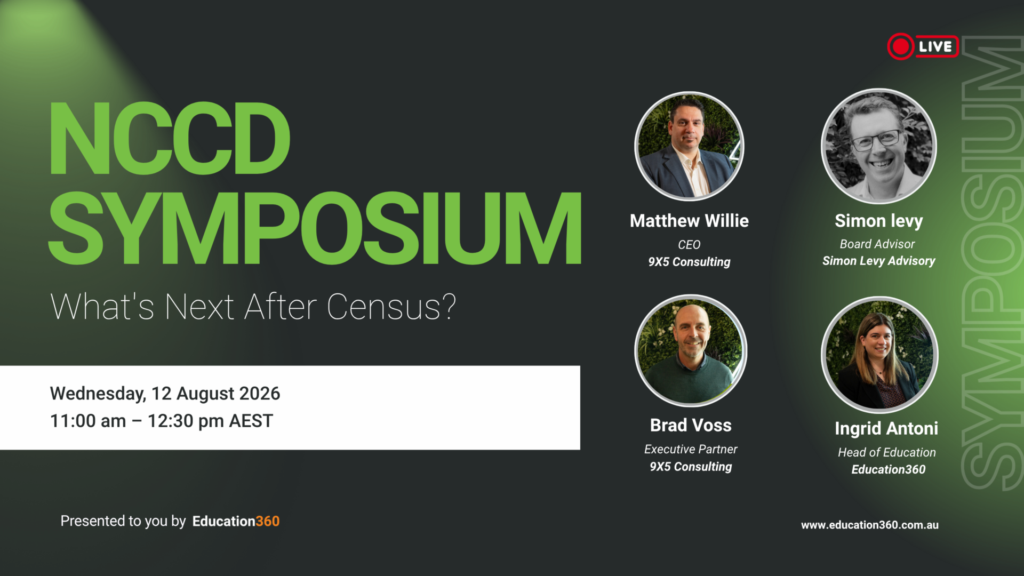
From Compliance to Confidence: Highlights from Our NCCD Leadership & Governance Symposium
Education360's October NCCD symposiums brought different parts of the school community together around one shared goal: building stronger, more confident NCCD practices. Our evening session focused specifically on the leadership, governance and oversight behind the annual collection.
This October, Education360 hosted two dedicated NCCD symposium sessions on the same day. While our first session explored evidence, adjustments and everyday practice for teachers and learning support teams, the NCCD Leadership & Governance Symposium shifted the conversation towards oversight, accountability, risk and strategic decision-making.
A Different Perspective on the Same NCCD Process
With more than 100 registrations across our October symposium sessions, the response reinforced how important NCCD continues to be across every level of a school.
Teachers and learning support teams experience NCCD through day-to-day student support, evidence and adjustments. For principals, deputy principals, business managers, board members and executive teams, the perspective is different.
School leaders need confidence that the processes behind the data are consistent, that decisions are supported by appropriate evidence and that the information ultimately being submitted can withstand review.
Looking at NCCD Through a Leadership Lens
NCCD is not only an administrative or classroom process. It also carries important governance responsibilities.
The Leadership & Governance Symposium explored how school leaders can build greater visibility across NCCD processes, understand where risks may emerge and strengthen confidence in the information being reported.
Rather than focusing only on the annual collection itself, the session considered what leaders need to know throughout the year in order to maintain effective oversight.
What the Session Focused On
Strong governance starts with knowing that NCCD decisions are supported, documented and visible across the school.
Audit readiness should not begin when a review is announced. It should be built into everyday processes.
Moving Beyond Compliance
A strong NCCD process is not simply about completing the annual collection on time.
For school leaders, confidence comes from understanding what sits behind the data: where evidence is stored, how adjustment decisions are made, whether responsibilities are clear and whether information can be accessed when needed.
When these processes are fragmented, leadership teams may have limited visibility until Census preparation, moderation or an audit brings gaps to the surface.
Stronger governance means creating systems that make those gaps easier to identify earlier.
Creating a Whole-School Approach
Effective NCCD governance depends on more than leadership alone.
Teachers, learning support staff, NCCD Coordinators and school leaders all contribute different parts of the process. The challenge is making sure those parts connect.
When expectations are clear and information is visible across teams, schools are better positioned to maintain consistent records, support stronger decision-making and prepare confidently for the annual collection.
Leadership therefore plays an important role in establishing the processes, systems and accountability that support good NCCD practice throughout the school.
Better Visibility Creates Better Confidence
One of the recurring themes across NCCD conversations is visibility.
Leaders need to be able to understand what is happening across the school without relying on information being manually gathered from multiple folders, systems or staff members.
Through NCCD360, schools can bring student information, adjustments, supporting evidence and reporting together in one place.
This gives leadership teams greater visibility across NCCD activity and makes it easier to understand progress, identify gaps and maintain confidence in the information supporting the annual collection.
Continuing the Conversation
The Leadership & Governance Symposium created an opportunity to look at NCCD beyond the operational level and consider what stronger oversight can look like in practice.
Together with our Inclusive Education & Practice session, it highlighted the importance of connecting everyday documentation with school-wide leadership and accountability.
Following the strong response to our October sessions, Education360 will host another NCCD symposium on 17 November.
We look forward to continuing the conversation and helping more schools strengthen their NCCD processes for the year ahead.

 By barbara luyza

 By Nandita Saravanan

 By Jessica Wijaya